The landscape
What your admin console can and cannot actually see, what you pay once you go past the bundle, how the vendors differ, and what provider economics suggest about where pricing goes next.
What you can, and can't, actually track
This is the question every finance and IT team asks, and the honest answer is "it depends what you bought." A subscription hides the meter; an API exposes it. Here's what each setup really lets you see, as of mid-2026.
| What you bought | Per-user visibility | Per-token / true cost | By model & tool | Programmatic API |
|---|---|---|---|---|
| ChatGPT Team seat-based |
Aggregate | Hidden | Limited | No |
| ChatGPT Enterprise credit-based, 2026 console |
Named users | Credits | Yes | Cost API |
| Claude Team pooled tokens |
Aggregate | Pool + caps | Some | No |
| Claude Enterprise Analytics API, 2026 |
Named users | $ per user | Model + tool | Analytics API |
| Microsoft 365 Copilot licence-based |
Adoption only | Hidden in licence | App adoption | Graph API |
| Grok Business seat-based, $30/user/mo |
Console analytics | Hidden in seat | Limited | No |
| Grok Enterprise custom pricing, SSO + SCIM |
Named users | Hidden in contract | Limited | Audit tools |
| Direct API OpenAI / Anthropic / etc. |
By key/tag | Exact tokens | Full detail | Full API |
Subscriptions hide the meter
Team and licence tiers mostly show adoption (active users, prompt counts, which apps), not what any single task cost. Good for "is anyone using this?", weak for "where is spend going?"
Enterprise adds the dashboard
Through 2026, all three vendors shipped admin consoles with per-user, per-model breakdowns and spend caps. ChatGPT bills Enterprise in credits; Claude Enterprise reports actual dollars per user. Both expose an API.
APIs expose everything
Direct API usage is the only place with true per-token, per-model, per-call cost, down to input, output and cache. Route calls through one gateway and tag by team, or the "one line called OpenAI" hides four different things.
The shadow-AI gap
None of this sees personal accounts. Analysts estimate most AI use in large firms happens on unsanctioned tools. A dashboard only covers what's on the corporate licence. The rest is invisible.
Vendor tooling in this area is changing month to month. Treat this as a mid-2026 snapshot and confirm against current admin docs before a procurement decision.
What you're actually paying for: bundles, caps and the meter behind them
Most people meet AI through a flat monthly fee: a seat, a subscription, a licence. That fee feels like the price. It isn't. It's the price of a bundle, meaning a set amount of usage the vendor has agreed to absorb. Every vendor now publishes what happens when you go past it, and in almost every case the answer is the same. You move onto a meter.
This section explains how the bundles work, where the meter starts, and why costs past that point can climb much faster than people expect. It also says plainly where "exponential" is the right word and where it isn't.
Prices checked 19 October 2026. All vendor prices are in US dollars, excluding VAT, as published on vendors' US pages. UK prices, currency and tax differ, so check your own checkout.
Every prompt runs a meter, in 80 seconds
A short, captioned explainer: the phone-credit model, why long chats cost more each turn, four habits that keep costs down, and what happens to a $25 seat once you go past its allowance.
Figures in the video are US list prices checked 19 October 2026, and the worked examples are illustrative. Sound on; captions can be switched off in the player.
Three ways you pay
1. Flat
A fixed price per person per month: ChatGPT Business, Claude Team, Microsoft 365 Copilot, Grok Business, Gemini inside Google Workspace. Within the allowance, heavy and light users cost exactly the same. The vendor carries the risk, so it also sets the limits, and it usually doesn't tell you exactly what they are. "More usage than Pro", "5x Standard" and "expanded" describe the allowance relative to another plan, not in units you can budget.
2. Flat, then metered
Once you exhaust the bundle you can wait, upgrade, or switch on paid extra usage. That extra usage is billed in credits or at API rates. Nearly every major vendor now offers this: Claude's paid plans ("turn on usage credits to keep working at standard API rates"), ChatGPT Business (pooled workspace credits), Google AI Pro and Ultra (AI credits for Flow and Antigravity), GitHub Copilot (AI Credits at $0.01 each), and Cursor and Grok (prepaid top-ups).
3. Pure usage
API access, and increasingly enterprise plans, bill every token. Claude Enterprise is now priced at "$20 per seat per month plus usage billed at API rates". ChatGPT Enterprise offers credit-based or token-based billing. Microsoft Copilot Studio agents bill per action in Copilot Credits.
The important shift is that the second and third models are spreading. The flat seat is becoming a starting allowance rather than an all-you-can-eat price.
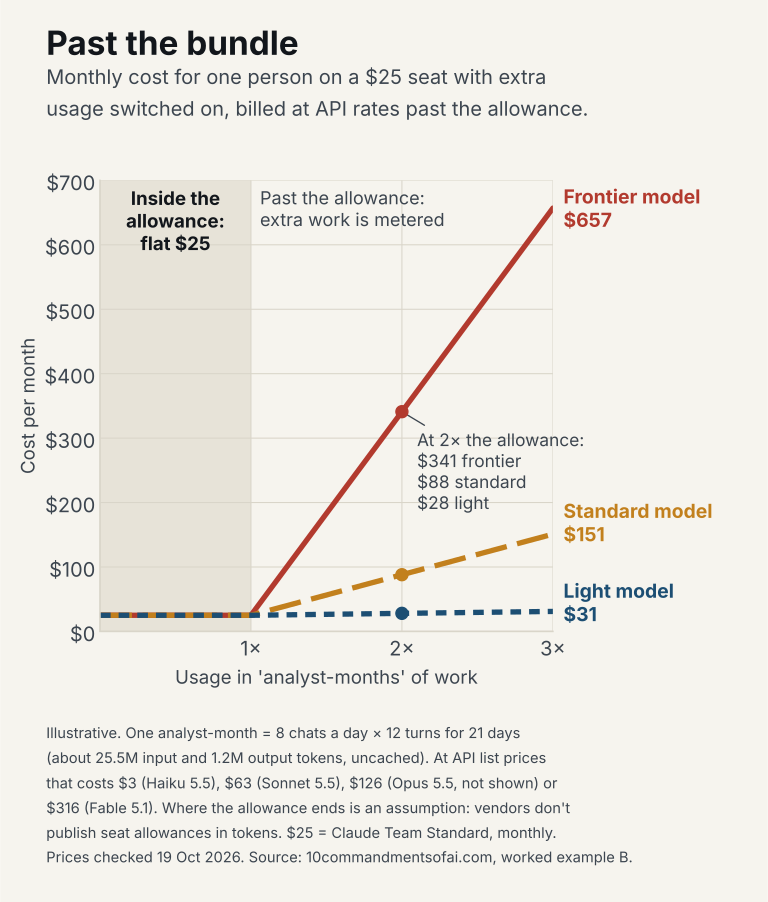
Flat inside the allowance, metered past it
Inside the allowance a seat is flat-priced. Past it, with extra usage switched on, every extra unit of work is billed at API rates, and the model you use sets the gradient.
Illustrative: one "analyst-month" is about 25.5 million input and 1.2 million output tokens, which costs $3 (Claude Haiku 5.5), $63 (Sonnet 5.5) or $316 (Fable 5.1) at list prices, uncached. Where the allowance ends is assumed: vendors don't publish seat allowances in tokens. Seat: Claude Team Standard, $25 monthly. Prices checked 19 October 2026. Worked example B below.
Where the bundle ends: the main plans side by side
Checked 19 October 2026. Prices change often. Verify before procurement.
| Vendor | Plan | Price (USD/month) | What the bundle includes | What happens past the cap | Source (accessed 19 Oct 2026) |
|---|---|---|---|---|---|
| OpenAI | ChatGPT Plus | $20 | Reasoning models, Codex and ChatGPT Work with "expanded" limits. Indicative Codex/Work allowance per 5-hour window: 5–45 messages on GPT-6 Astra, 350–3,000 on GPT-6 Luna | Wait for reset, upgrade, or buy credits for Codex, Work, Word, Excel and PowerPoint | help.openai.com/en/articles/6950777; learn.chatgpt.com/docs/pricing.md |
| OpenAI | ChatGPT Pro 100 / 200 / 500 | $100 / $200 / $500 | Larger allowances. Only Pro 500 includes Ultrafast. New Pro 200 subscriptions get a lower allowance than before at the same $200 price (change dated 29 Sept 2026) | Credits. Ultrafast draws included usage at 8× the standard rate, then credits at 6× | help.openai.com/en/articles/9793128 |
| OpenAI | ChatGPT Business: Standard / Premium seat | $25 monthly or $20 annual / $125 monthly or $100 annual | Per-seat limits on advanced features. Premium has 5× Standard usage and no 5-hour limit. 2-seat minimum | Workspace credits at about $0.04 per credit (2,500 credits = $100). GPT-6 message = 10 credits; GPT-6 Pro message = 50; agent-mode message = 30; deep research task = 50. Default: no per-seat credit limit set | help.openai.com/en/articles/8792536; /11481834 (rate card); /20001155; cfotech.news (credit value) |
| OpenAI | ChatGPT Enterprise | Contact sales | Credit-based or token-based billing; shared pool, "no per-seat usage caps by default" | When the pool is exhausted, features pause unless the owner enables overages or buys more | openai.com/business/pricing; help.openai.com/en/articles/11487671 |
| Anthropic | Claude Pro / Max 5x / Max 20x | $20 ($17 annual) / $100 / $200 | Limits reset every 5 hours, plus weekly limits. Max is 5× or 20× Pro per session. Max includes $100–$200 a month in API credits (these do not cover chat overage) | Optional usage credits "at standard API rates", with a monthly spend cap you choose. "Set to unlimited" is an option | claude.com/pricing; support.claude.com/en/articles/12429409 |
| Anthropic | Claude Team: Standard / Premium seat | $25 monthly or $20 annual / $125 monthly or $100 annual | Standard: 1.25× Pro's per-session allowance plus a weekly limit. Premium: 6.25× Pro. 2–150 seats. Pooled API credits up to $500 a month | Extra usage available. Admin spend controls | support.claude.com/en/articles/9266767; /9267289 |
| Anthropic | Claude Enterprise | $20 per seat + usage at API rates | Seat covers access and admin. All usage is metered | Metered from the first token | claude.com/pricing (FAQ) |
| Google AI Pro / Ultra 5x / Ultra 20x | $19.99 / $99.99 / $199.99 | Pro has 4× free-tier limits and a 1M-token context. Ultra has 5× or 20× Pro. Limits refresh every five hours up to a weekly cap. Includes Flow credits (1,000 / 10,000 / 25,000) | Buy AI credits for Flow, Antigravity and other supported products (credit price not confirmed) | one.google.com/about/google-ai-plans; support.google.com/googleone/answer/16286513 | |
| Workspace Business Standard (Gemini included) | $14 annual / $16.80 flexible, per user | Fixed monthly quotas for each feature, for example 100 generated slides, 5,000 Sheets AI-function calls, 30 Nano Banana Pro images | AI Expanded Access add-on raises the quotas (price not published on the help page). Some quotas start being enforced on 1 Nov 2026 | knowledge.workspace.google.com (business editions; AI Expanded Access) | |
| Microsoft | Microsoft 365 Copilot (enterprise add-on) | $30 per user, annual | Copilot in Word, Excel, PowerPoint, Outlook and Teams. Licensed users can use employee-facing Copilot Studio agents "at no charge", within fair-use limits | Newer services such as Cowork, Copilot Code and Work IQ API are metered in Copilot Credits. Copilot Studio pay-as-you-go is $0.01 per credit, or $200 for a 25,000-credit pack | microsoft.com/en-us/copilot/pricing/enterprise; learn.microsoft.com (usage-based billing; Copilot Studio billing rates) |
| Microsoft | Copilot Chat + agents (no Copilot licence) | Included with eligible M365 | Web-grounded chat | Agents are metered. Generative answer = 2 credits; agent action = 5; tenant-graph grounding = 10; reasoning-model tokens = 10 credits per 1,000 tokens on top | learn.microsoft.com/microsoft-copilot-studio/requirements-messages-management |
| SpaceXSI (xAI) | The X Subscription: Plus / Premium / Super / Ultra (Grok + Cursor + X) | $8 / $30 / $100 / $200 | One weekly usage pool shared across Grok and Cursor. Premium is 4×, Super 15× and Ultra 50× Plus | Top-ups. Third-party models in Cursor billed at API list price from the first request | x.ai/pricing; x.ai/news/x-subscription |
| SpaceXSI (xAI) | Grok Business | $30 per user | Grok 4.7, Imagine, Voice, connectors, admin | Enterprise is custom | x.ai/grok/business |
| GitHub | Copilot Pro / Pro+ / Max | $10 / $39 / $100 | 1,500 / 7,000 / 20,000 AI Credits a month (base plus a variable "flex allotment"). Completions unlimited | Pay per token at 1 AI Credit = $0.01, against a budget you set | docs.github.com (usage-based billing for individuals) |
| GitHub | Copilot Business / Enterprise | $19 / $39 per seat | 1,900 / 3,900 credits per user, pooled across the organisation | $0.01 per credit beyond the pool | docs.github.com (organisations and enterprises billing) |
| Cursor | Plans under The X Subscription; Teams $30/$100/$200 per seat | As above | Weekly pool for Cursor's own models (Grok 4.x, Composer) | Third-party models (Claude, GPT, Gemini) at API list price. Teams/Enterprise add a $0.25 per million token "Cursor Token Rate" | cursor.com/docs/models-and-pricing |
What the table tells you
No major business plan is truly unlimited for the expensive features any more. Most say "unlimited" only for the lightest model, for example ChatGPT's "Instant" or GitHub's code completions. Everything else is a bundle with a meter behind it.
The default limit is often off
In several of the most widely used products the default spending limit is off, so the decision falls to whoever configures the account. ChatGPT Business: "By default, all seats and users have no limits specified". Claude offers "Set to unlimited". Microsoft auto-adds new metered services to spending policies by default.
What the meter charges: API rates for the flagship tiers
Per million tokens, standard tier, US dollars, checked 19 October 2026.
| Model (vendor) | Input | Output | Cheap tier for comparison | Long-context or other surcharges |
|---|---|---|---|---|
| GPT-6 Astra (OpenAI) | $10 | $50 | GPT-6 Luna: $0.10 / $0.50 | Above 272K input tokens: $20 / $75. Fast mode costs 2×; Ultrafast for Astra is $60 / $300 (6×). Data-residency endpoints add 10% |
| GPT-6.1 Sol (OpenAI) | $2 | $10 | As above | Above 272K: $4 / $15 |
| Claude Fable 5.1 (Anthropic) | $10 | $50 | Claude Haiku 5.5: $0.10 / $0.50 | No long-context surcharge on 4.6+ models except Haiku 5.5, which costs 5× above 100K tokens. US-only inference costs 1.1× |
| Claude Opus 5.5 (Anthropic) | $4 | $20 | As above | Fast mode $8 / $40 |
| Gemini 4 Argon (Google) | $2 (rising to $4 on 1 Dec 2026) | $10 (rising to $20) | Gemini 3.1 Flash-Lite: $0.25 / $1.50 | Output price includes thinking tokens |
| Grok 4.7 (SpaceXSI) | $2 | $6 | Not listed | Prompts of 200K tokens or more: $4 / $12 on all tokens in the request. Priority processing costs 2× |
Sources: developers.openai.com/api/docs/pricing; platform.claude.com/docs/en/about-claude/pricing; ai.google.dev/gemini-api/docs/pricing (last updated 16 Oct 2026); docs.x.ai/developers/pricing. All accessed 19 October 2026.
Output costs about five times input
Across almost every flagship model: $10 against $50, $4 against $20, $2 against $10. Reasoning models bill their hidden "thinking" as output. OpenAI's pricing page says output prices "include… reasoning tokens, even though reasoning tokens are not visible."
The gap between tiers is about 100×
That's wider than the 50–60× this site's calculators assume. GPT-6 Luna to GPT-6 Astra is $0.10 to $10 for input, and Claude Haiku 5.5 to Fable 5.1 is the same.
Some current prices are introductory
Gemini 4 Argon doubles on 1 December 2026. OpenAI says GPT-5.6 Sol's promotional pricing runs "at least through November 21, 2026". Budget on the post-promotion price.
Why costs past the bundle can escalate so fast
Six mechanisms, and what kind of growth each one produces.
1. The cliff edge: flat becomes metered
Inside a bundle, your marginal cost is zero. One message past it, you pay full rate. That's a change in kind, not degree. It's why heavy users look cheap right up until the moment they don't.
Shape: a step, then a straight line.
2. Model choice multiplies everything
The same work on a flagship model costs about 100× what it costs on a light one. Ramp, the corporate-card provider, calls "model tier migration" (teams quietly moving from a lightweight model to a frontier one) the single biggest driver of unexpected AI cost increases.
Shape: a constant multiplier, but a large one.
3. Long chats grow with the square of their length
Every message resends the whole conversation. The cost of turn n therefore grows with n, and the total cost of a thread grows with n². In the worked example below, doubling a thread from 20 to 40 turns raises its cost about 3.3 times. Going from 40 to 80 turns raises it about 3.5 times.
Shape: quadratic. This is "compounding" in the everyday sense, not exponential in the mathematical sense.
4. Long-context surcharges switch on above a threshold
OpenAI charges 2× input and 1.5× output above 272K tokens. Grok charges 2× on every token in the request once the prompt reaches 200K. Claude Haiku 5.5 charges 5× above 100K.
Shape: a step that applies to the whole request, not only to the tokens over the line.
5. Agents call the model in a loop
One instruction can become dozens or hundreds of model calls. Each call carries the growing context of the ones before it, so a single agent task is a long chat that the machine has with itself. Sub-agents multiply this again. GitHub's own billing guidance says an agentic session "will consume significantly more usage than a quick question in chat". OpenAI puts typical Codex cost at "$100–$200 per developer per month", while noting that it "varies significantly".
Shape: quadratic per task, multiplied by the number of agents running in parallel.
6. Multipliers stack
Premium speed modes (2× for Fast, 6× for Ultrafast), long-context surcharges (1.5–2×), data residency (1.1×) and model tier (up to about 100×) all multiply together. Ultrafast GPT-6 Astra on a long prompt is listed at $120 input / $450 output per million tokens. GPT-6 Luna on a short prompt is $0.10 / $0.50. That's 1,200× on input and 900× on output from the same vendor, on the same page.
Shape: the product of every multiplier you have switched on.
It's worth being precise, because a finance reader will be. Per conversation or per agent task, cost is quadratic, not exponential: "grows with the square of the length" is accurate and defensible. Between plans and models, the jump is multiplicative: "a hundred times", "orders of magnitude" or "1,200× on the same price list" are accurate, and more striking than "exponential". "Exponential" in the strict sense applies only where something compounds at a steady rate, such as agents that spawn sub-agents which spawn their own, or spend that grows by a fixed percentage every month. Ramp recorded the top 1% of firms growing AI spend per employee by 14.1% in a single month (June 2026 index). Sustained, that would be exponential, but its October index shows growth stalling. Caps and spend limits are what stop either from running away. In short: past the bundle, costs don't rise in a straight line. They multiply. Pick a premium model, keep a long thread or hand the task to an agent, and the same work can cost tens to hundreds of times more.
Worked example: the same work, bundled and metered
Illustrative only. These are not measurements of any real person or vendor's internal allowance. The token counts are assumptions. The prices are published list prices, checked 19 October 2026. Caching is shown because it matters, but how much you actually get depends on the tool.
A. One long chat versus fresh chats
Assumptions: 3,000 tokens of system instructions and tools, 400 tokens per question and 600 tokens per answer. Claude Opus 5.5 at $4 input / $20 output per million tokens. No caching.
| Turns in one thread | Tokens processed (input) | Cost of the thread | Average cost per turn |
|---|---|---|---|
| 1 | 3,400 | $0.03 | $0.026 |
| 10 | 79,000 | $0.44 | $0.044 |
| 20 | 258,000 | $1.27 | $0.064 |
| 40 | 916,000 | $4.14 | $0.104 |
| 80 | 3,432,000 | $14.69 | $0.184 |
Forty questions in one thread cost about $4.14. The same forty questions as forty fresh chats cost about $1.02, four times less. The 40-turn thread on GPT-6 Astra or Claude Fable 5.1 costs about $10.36. On GPT-6 Astra Ultrafast it costs about $62. On Claude Haiku 5.5 or GPT-6 Luna it costs about $0.10.
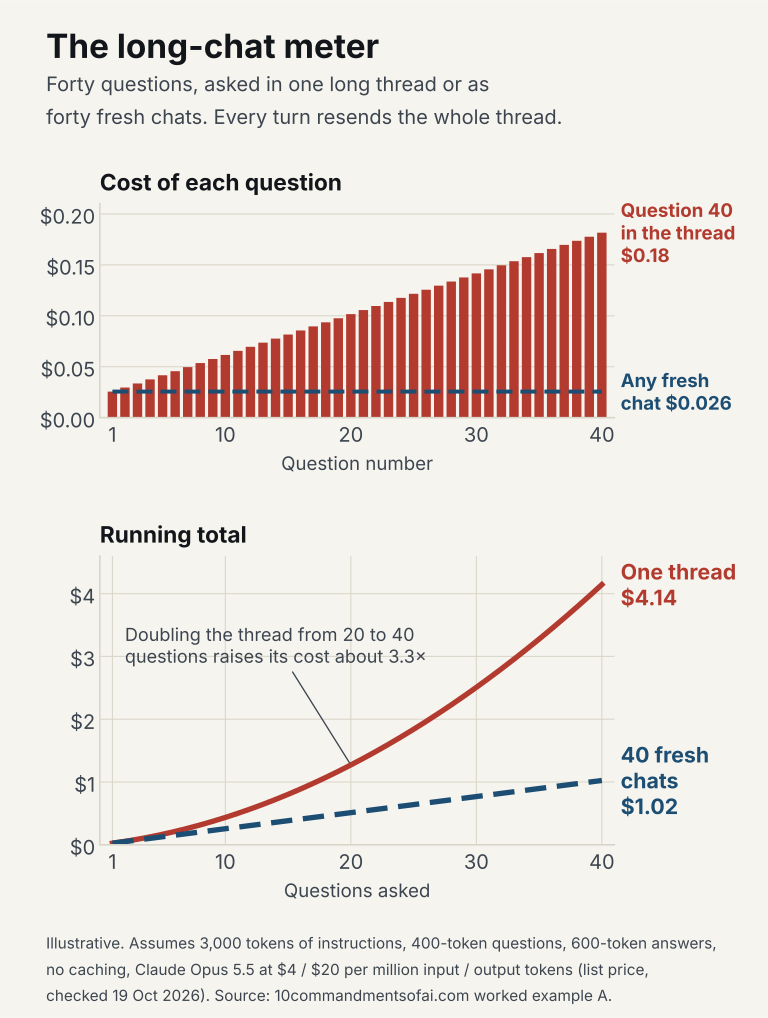
Each question costs more than the last
Every turn resends the whole thread, so each question costs more than the last and the total grows with the square of the thread's length.
Illustrative: assumes 3,000 tokens of instructions, 400-token questions and 600-token answers, no caching, and Claude Opus 5.5 at $4 / $20 per million input / output tokens (Anthropic list price, checked 19 October 2026). Worked example A.
B. An analyst on a seat versus at API rates
Assumptions: 8 chats a day, 12 turns each. Two of the chats include a 15,000-token document. 21 working days. That comes to about 25.5 million input tokens and 1.2 million output tokens a month.
| Billing route | Monthly cost |
|---|---|
| Claude Team Standard seat (monthly billing) | $25, if the work fits inside the seat's limits (Anthropic doesn't publish the allowance in tokens) |
| Same usage at API rates, Claude Sonnet 5.5 | $63 uncached / about $24 with 80% cache reads |
| Same usage at API rates, Claude Opus 5.5 | $126 uncached / about $49 cached |
| Same usage at API rates, Claude Fable 5.1 | $316 uncached / about $117 cached |
| Same usage at API rates, Claude Haiku 5.5 | $3 uncached / about $1 cached |
The seat is excellent value for this person as long as they stay inside it. On Claude Enterprise ($20 per seat plus usage at API rates), or once extra usage is switched on, the right-hand figures are what you pay. Model choice alone moves the bill from about $3 to about $316 a month for identical work.
C. An engineer running a coding agent
Assumptions: each task makes 60 model calls. Context starts at 20,000 tokens and grows by 2,500 per call, to about 167,000 by the end. Each call outputs 1,200 tokens. Four tasks a day, 21 days. That's about 5.6 million input tokens per task.
| Model | Per task, uncached | Per task, 90% cache hits | Per month, uncached | Per month, cached |
|---|---|---|---|---|
| Claude Sonnet 5.5 / GPT-6.1 Sol | $11.97 | $2.63 | $1,005 | $221 |
| Claude Opus 5.5 | $23.94 | $5.26 | $2,011 | $442 |
| Claude Fable 5.1 / GPT-6 Astra | $59.85 | $11.90–$15.69 | $5,027 | $999–$1,318 |
Halve or double the number of calls in a task and the cost moves by more than double. On Opus 5.5 uncached, the same task costs $7.47 at 30 calls, $23.94 at 60 and $83.88 at 120.
For comparison, the developer seats in the table above cost $20–$200 a month. These modelled figures sit in the same range as the reported real-world numbers. Uber engineers were reported to be spending $500–$2,000 a month before Uber capped spend at $1,500 per month per tool (Bloomberg, 2 June 2026; Forbes, 17 May 2026).
D. Credits on a business seat
On ChatGPT Business, one GPT-6 Pro message billed in credits costs 50 credits, about $2. A user who sends ten a day past their allowance adds about $420 a month to a $25 seat (10 messages × 21 days × 50 credits × $0.04).
On Microsoft Copilot Studio, a single agent answer grounded in company data costs 12 credits ($0.12) at pay-as-you-go rates. If it uses a reasoning model producing 3,000 tokens, the premium meter adds 30 credits, making about $0.42 per answer. That's trivial for one answer, but material for an agent answering thousands of unlicensed staff every day.
What to do about it: tying back to the ten rules
None of this argues for using AI less. A $25 seat that saves an analyst five hours a week is a bargain. The point is that the bundle is generous and the meter is not, and the habits on this site decide which one you live on.
Sources for this section (all accessed 19 October 2026 unless stated)
- OpenAI: ChatGPT pricing page, plan features and context windows. openai.com/chatgpt/pricing
- OpenAI Help: What is ChatGPT Plus? ($20 a month). help.openai.com/en/articles/6950777
- OpenAI Help: About ChatGPT Pro tiers (Pro 100/200/500; Ultrafast 8× allowance, 6× credits; Pro 200 allowance change). help.openai.com/en/articles/9793128
- OpenAI: Codex/Work pricing and indicative 5-hour message ranges. learn.chatgpt.com/docs/pricing.md
- OpenAI Help: Managing billing and seats in ChatGPT Business (Standard $25/$20; Premium $125/$100). help.openai.com/en/articles/8792536
- OpenAI Help: ChatGPT Rate Card for Business and Enterprise/Edu (credits per message and per million tokens; Fast 2×; Ultrafast 6×; Codex "$100–$200 per developer per month"). help.openai.com/en/articles/11481834
- OpenAI Help: Flexible pricing for Enterprise, Edu and Business (credit pools; overage behaviour; credits valid 12 months). help.openai.com/en/articles/11487671
- OpenAI Help: Managing credits and spend controls in ChatGPT Business ("By default, all seats and users have no limits specified"). help.openai.com/en/articles/20001155
- CFOtech: OpenAI launches Premium seats ("$100 in workspace credits, equal to 2,500 credits"). cfotech.news
- OpenAI: Business pricing (Enterprise credit- or token-based). openai.com/business/pricing
- OpenAI: API pricing (GPT-6 Astra, 6.1 Sol and Luna; long context above 272K; reasoning tokens billed as output; Fast/Ultrafast; 10% residency uplift). developers.openai.com/api/docs/pricing
- Anthropic: Claude pricing (Pro, Max, Team, Enterprise "$20 per seat… plus usage billed at API rates"; usage-limit FAQ). claude.com/pricing
- Anthropic Help: Manage usage credits for paid Claude plans. support.claude.com/en/articles/12429409
- Anthropic Help: What is the Team plan? (seat prices; 1.25× and 6.25× Pro allowance). support.claude.com/en/articles/9266767
- Anthropic Help: How is my Team plan bill calculated? (pooled API credits capped at $500). support.claude.com/en/articles/9267289
- Anthropic: API pricing (model rates; caching multipliers; Haiku 5.5 above 100K; fast mode; tokeniser about 30% more tokens on 4.7+). platform.claude.com/docs/en/about-claude/pricing
- Google: Google AI plans (AI Plus/Pro/Ultra prices; limits; Flow credits). one.google.com/about/google-ai-plans
- Google One Help: Use Google AI Ultra benefits (AI credits for extra usage). support.google.com/googleone/answer/16286513
- Google Workspace Help: Business editions and AI Expanded Access (Business Standard $14/$16.80; feature quotas; enforcement from 1 Nov 2026). knowledge.workspace.google.com
- Google: Gemini Developer API pricing (Gemini 4 Argon $2/$10 to 30 Nov 2026, then $4/$20; last updated 16 Oct 2026). ai.google.dev/gemini-api/docs/pricing
- Microsoft: Copilot plans for enterprise (M365 Copilot $30 per user per month, annual; metered agents). microsoft.com/en-us/copilot/pricing/enterprise
- Microsoft: Copilot Studio pricing ($200 for 25,000 credits; pay-as-you-go). microsoft.com/en-us/copilot/pricing/copilot-studio
- Microsoft Learn: Copilot Studio billing rates (credits per feature; reasoning premium 10 credits per 1,000 tokens; 125% overage enforcement). learn.microsoft.com
- Microsoft Learn: Usage-based billing for Copilot Credits (Cowork, Code, Work IQ API metered; "Auto-apply new services" on by default). learn.microsoft.com
- SpaceXSI (xAI): Pricing, The X Subscription. x.ai/pricing and x.ai/news/x-subscription
- SpaceXSI (xAI): Grok Business ($30 per user per month). x.ai/grok/business
- SpaceXSI (xAI): API pricing (Grok 4.7; 200K long-context rule; priority 2×). docs.x.ai/developers/pricing
- GitHub Docs: Usage-based billing for individuals (AI Credits; $0.01 per credit; plan allowances). docs.github.com
- GitHub Docs: Usage-based billing for organisations and enterprises (Business $19, Enterprise $39; pooled credits). docs.github.com
- Cursor Docs: Models and pricing (plans; third-party models at API list price; Cursor Token Rate). cursor.com/docs/models-and-pricing
- Ramp: AI Index June 2026 (median $11.38; top 1% $7,450; top 1% +14.1% month on month), published 26 June 2026. ramp.com/data/ai-index-june-2026
- Ramp: AI Index October 2026 (top 1% $9,568 in September; growth stalling), published 14 October 2026. ramp.com/data/ai-index-oct-2026
- Ramp: What drives unexpected AI token cost increases (model tier migration). ramp.com/blog
- Bloomberg: Uber caps employee spending on AI tools (2 June 2026). bloomberg.com. Forbes: Uber burns its 2026 AI budget in four months (17 May 2026). forbes.com
Not yet confirmed at the time of checking: Google AI credit pricing; the price of Google's AI Expanded Access add-on; the exact token size of any seat's allowance (no vendor publishes it). The GitHub Business and Enterprise figures should be reconfirmed on GitHub's page.
How the three stacks meter cost
Same goal (contain and understand spend), three different mental models. Knowing which one you're in tells you how to budget and what to watch.
Seats, then credits
Team buys seats. Enterprise moved to a credit model with a 2026 Global Admin Console: slice consumption by user, group, project and model, set workspace defaults, cap power users, pull it via a Cost API. Office and agent features now meter in tokens too.
A utility meter
No seat limits: usage draws from one org token pool, with spend caps at every level. Enterprise analytics report cost by group and by user, showing artifacts, files and tools next to their cost, filtered by your existing org chart. Two APIs expose it.
Bundled in the licence
Cost lives inside the M365 licence, so admin reporting is about adoption, not spend: active users, prompts, app usage, agent uptake (via the admin centre, Viva Insights and Graph API). Great for rollout tracking, quiet on per-task cost.
Seats with a console
Business and Enterprise tiers arrived in January 2026: Business at $30 per seat, Enterprise on custom pricing. Management runs through the xAI console: seats, consolidated billing, role-based controls and usage analytics, with Enterprise adding SSO, SCIM directory sync, audit tooling and a customer-key data vault. Cost sits inside the seat, so reporting leans toward adoption rather than per-task spend.
Gemini and other Workspace-bundled assistants follow broadly the licence-based pattern described for Copilot (cost inside the licence, reporting focused on adoption) but aren't broken out separately here. Check current admin documentation before relying on any of this for procurement.
What today's prices are really telling you
Everything above treats AI pricing as a fact of life. It isn't. It's a moment in a market that hasn't settled. Understanding what providers charge versus what it costs them to serve you explains why prices move the way they do, and why building the habits on this page now is worth more than waiting for costs to fall.
The providers are not all making money
Anthropic: margin recovered fast
Gross margin moved from roughly −94% in 2024 to about 60% in 2026, driven by inference efficiency rather than price rises: blended token prices have been falling throughout. Revenue per megawatt of compute rose from about $16m to a projected $60m in under a year. Enterprise API mix is the reason: business customers generate several times more revenue per token than consumer users, and their query patterns are cheaper to serve.
OpenAI: scale without margin
Gross margin was around 33% in 2025, improving to roughly 39% in early 2026, against a $20.9bn operating loss on $13.07bn of revenue. The drag is structural: a very large free consumer tier consuming inference without matching revenue. Internal plans point to cumulative losses near $115bn through 2029 before cash-flow profitability around 2029–30.
Cheaper per query, bigger bills
Inference cost per query has fallen roughly 95% since early 2023. Total spend still rose, because agentic workloads consume many times more tokens per task than a chat message. Whether margins expand depends on whether costs fall faster than demand grows, and so far demand has won.
Figures from press reporting and analyst estimates during 2026, in US dollars. These are private companies; numbers are leaked, estimated or self-reported, and both firms have been reported as missing their own margin targets. Treat as direction of travel, not audited fact.
The margin ladder is being squashed
Classic software earned its valuations on near-zero marginal cost: build once, serve the next customer for almost nothing. AI breaks that in exactly one place: every use spends real compute, so inference lands in cost of goods sold rather than fixed R&D. The result is a visible compression.
Gross margin by business type
Median software gross margin across 342 SaaS and AI-native companies was 80% for full-year 2025, with top-quartile at 86% and usage-only pricing at 62%. ICONIQ's survey of roughly 300 software executives puts average AI product gross margin at 41% in 2024, 45% in 2025 and 52% in 2026. Most analysts expect a structural floor around 60–65% rather than a return to 80%+.
Compression, not collapse
AI margins are improving (41% to 52% in two years), but the consensus is they settle in the 60–65% band rather than returning to the SaaS 80%. Traditional software adding AI features typically gives up 12–17 points. The old 80% benchmark is unlikely to come back as the industry standard.
What that means for buyers
Vendors facing structurally lower margins have to recover cost somewhere: usage-based pricing, credit systems, tiering and caps. That's precisely the shift described earlier on this page. Expect more metering, not less, and expect the meter to be passed to you.
Why waiting is not a strategy
Per-token prices have fallen sharply and will likely keep falling. Total spend still went up. If cheaper tokens simply invite more use (longer threads, more agent calls, more re-runs), then discipline, not price, is what determines your bill. Efficiency compounds in a way that waiting does not.
Where the value settles: data, not models
Software went from "tech companies" as a single category to fintech, regtech, proptech, healthtech and the rest. AI looks likely to segment the same way, and the dividing line is emerging as proprietary data and workflow depth rather than model access.
Model access is not a moat
Everyone can reach the same frontier models on similar terms, so capability alone stopped being differentiating. Investor language has shifted markedly during 2026 away from thin wrappers and toward workflow ownership, proprietary data and domain depth. One investor went as far as saying the terminal value of software itself is now being questioned.
What defends a position
A Stanford CodeX white paper ranks vertical AI moats in ascending strength: workflow and interface, vertical tooling, built-in compliance, and strongest of all the accumulated data layer. Regulated verticals (legal, healthcare, financial services) score highest, because domain knowledge and compliance are slow to replicate whatever the model can do.
The compounding loop
Use generates data, data improves the product, the better product drives more use. Sectors where the data is both proprietary and directly useful to model performance benefit most. The honest caveat: most software companies discover on inspection that they don't have a data moat. They have a head start, and head starts erode.
This last section is interpretation rather than instruction. The figures are sourced, but the conclusion (that margins converge toward a common band and AI segments by data moat rather than by model) is a reasonable reading of where things are heading, not a certainty. The practical takeaway is narrower and safer: pricing is unsettled, metering is increasing, and the habits described above are what you actually control.